
- All
- Product Name
- Product Keyword
- Product Model
- Product Summary
- Product Description
- Multi Field Search
Views: 0 Author: Site Editor Publish Time: 2026-10-16 Origin: Site


Substandard safety gear creates massive legal liabilities daily and jeopardizes human lives. Unqualified middlemen frequently hide behind polished websites in today's volatile global supply chains. This makes identifying legitimate manufacturing partners increasingly difficult. Rigorous vetting is no longer just best practice. It is an absolute necessity to prevent dangerous financial losses and ensure user safety.
Establishing a foolproof evaluation process is non-negotiable whether you are importing a basic medical mask or a highly specialized hazmat suit. We share essential bottom-of-funnel questions you must ask today in this comprehensive guide. Integrating these targeted inquiries into your procurement strategy allows you to confidently evaluate any PPE supplier and secure a resilient supply chain.
Verify Compliance First: Always demand verifiable third-party test reports and international regulatory certifications including FDA registration, CE marking, or NIOSH approval.
Assess Manufacturing Reality: Accurately distinguish between true manufacturers and trading companies by asking detailed questions regarding internal quality control procedures and actual production capacity.
Explore OEM Capabilities: Confirm the facility’s ability to provide custom packaging, material specifications, and private labeling if corporate brand identity is a priority.
Prioritize Supply Chain Transparency: A reliable procurement partner should maintain a documented Code of Conduct, sustainable raw material sourcing strategies, and completely transparent production lead times.
Request Physical Samples: Never place a bulk commercial order for critical items without first evaluating physical samples for functional performance and material durability.
Procuring personal protective equipment carries a unique set of high-stakes responsibilities in global trade. Choosing the wrong manufacturing partner for safety gear has an immediate and severe bottom-line impact. The importer bears the brunt of the legal and financial consequences when a supplier fails to meet stringent international standards.
Recent industry data reveals a sharp pivot in global procurement strategies. Following the supply chain shocks of recent years, regulatory bodies like the FDA and EMA have deployed AI-driven analytics to intercept fraudulent shipments at ports. Buyers are moving away from spot-buying. Instead, they prioritize long-term contracts with vetted facilities that offer full traceability. A seized shipment results in total financial loss for the order, exorbitant port storage fees, and severe disruptions to your inventory pipeline. The legal ramifications multiply if non-compliant gear somehow bypasses customs and reaches end-users. Selling unverified equipment exposes importers to devastating product liability lawsuits and irreversible brand damage.
Consequently, establishing a long-term partnership with a rigorously vetted facility is a strategic necessity. A qualified partner stabilizes your inventory through predictable lead times and ensures consistent product quality across multiple production batches. Importers mitigate supply chain bottlenecks and ultimately safeguard lives by conducting thorough due diligence before signing a contract.
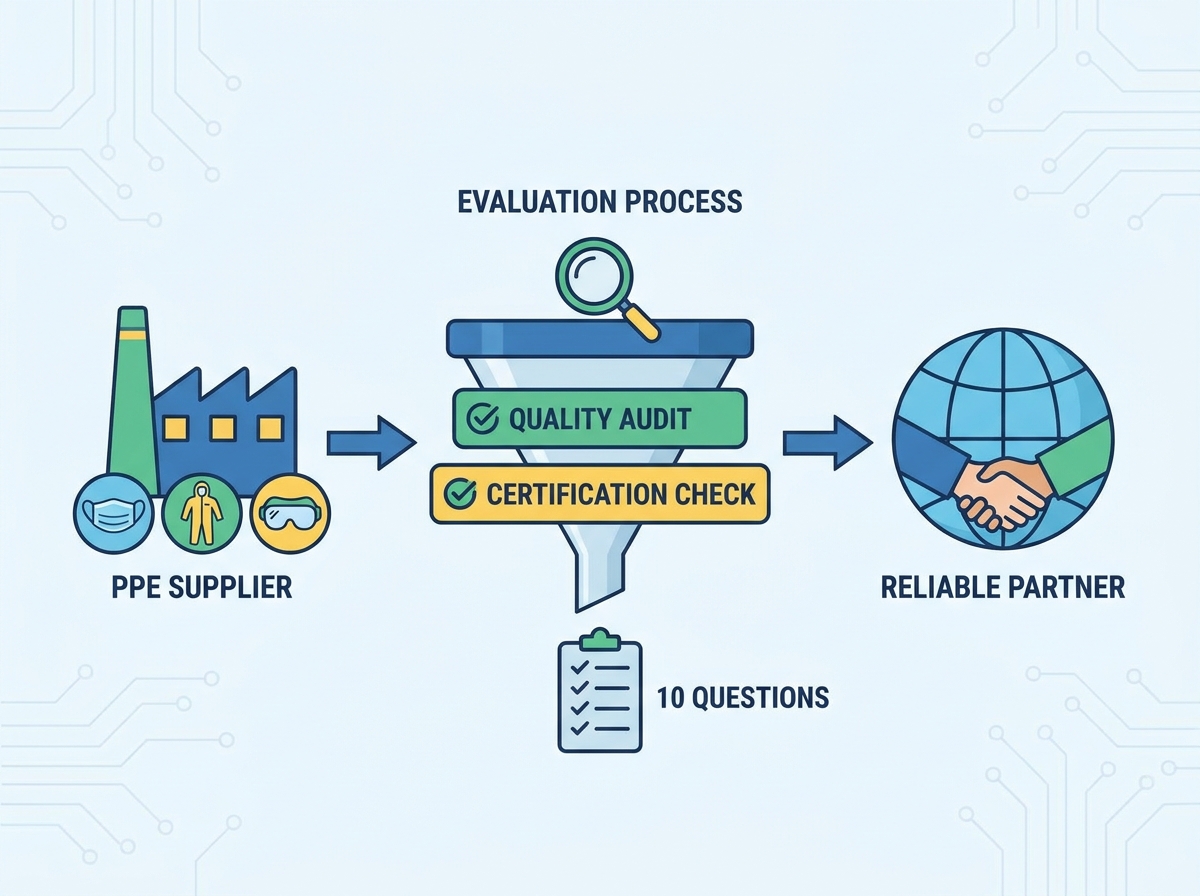
Evaluating regulatory compliance is the foundational step in vetting any manufacturer. Importers must rigorously verify that the facility adheres to the exact legal and safety requirements of their target market.
Different regions require distinct regulatory approvals. A competent manufacturer should readily provide documentation tailored to your specific jurisdiction. Specifically, products entering the European market must carry a valid CE mark demonstrating compliance with the PPE Regulation EU 2016/425 or the Medical Device Regulation. Importers targeting the United States must look for FDA establishment registration, 510k clearances for medical-grade items, or NIOSH approvals for respiratory protection.
It is not enough to simply accept a PDF certificate at face value. Importers must actively cross-reference the provided document numbers with official databases. CE certificates should be verified through the NANDO database to confirm the Notified Body's authority. Similarly, FDA registrations must be checked directly on the official FDA portal.
General company certifications indicate basic quality management but do not prove that a specific item meets stringent safety standards. Importers must request batch-specific or product-specific lab test reports from accredited independent third-party laboratories.
The manufacturer must provide a test report from a recognized facility like Nelson Labs or SGS when sourcing filtration devices. This report should explicitly detail the Bacterial Filtration Efficiency, Particulate Filtration Efficiency, and fluid resistance levels. Treat it as a glaring red flag indicating potential non-compliance if the supplier hesitates to share full unredacted test reports.
Understanding the operational reality of a factory is essential to weed out unreliable middlemen. This guarantees consistent product quality batch after batch.
A documented multi-stage quality control process is the absolute hallmark of a professional operation. Importers should inquire about the specific inspection stages implemented directly on the factory floor. A robust system typically includes Incoming Quality Control to inspect raw materials before production begins. It also requires In-Process Quality Control to monitor the assembly line and catch defects early, followed by Final Quality Control to evaluate the finished packaged goods.
Ask the facility to provide their standard operating procedures for handling defective batches. A reliable partner will operate under an ISO 13485 framework ensuring that every step of the manufacturing process remains traceable and standardized.
Transparency regarding the production origin is crucial. Importers must accurately distinguish between direct manufacturers and trading companies. To simplify your evaluation process, use the following comparison matrix:
Evaluation Metric | Direct Manufacturer | Trading Company / Middleman |
|---|---|---|
Pricing Structure | Factory-direct pricing with higher margins for importers. | Marked-up prices to cover their intermediary commission. |
Quality Control | Direct oversight of IQC, IPQC, and FQC on the factory floor. | Relies on third-party factories; inconsistent batch quality. |
Customization | Full control over molds, materials, and private labeling. | Limited to standard off-the-shelf products. |
Accountability | Directly responsible for CAPA and defect replacements. | Often shifts blame to the hidden subcontractor. |
Partnering with a direct facility offers better pricing margins and stricter centralized control over critical items. Ask for factory audit reports or request live video tours of the production line before transferring any funds.
The complexity of safety equipment varies drastically. A supplier's specialization dictates the quality, durability, and reliability of their technical items.
Manufacturing basic disposable shoe covers requires vastly different machinery and environmental controls than producing a highly technical protective suit designed for hazardous material handling. A Type 5/6 microporous coverall weighing 55-65 GSM demands strict cleanroom environments to prevent contamination. It also requires specialized ultrasonic seam sealing technology to ensure fluid resistance.
Producing reliable protective goggles involves precise injection molding. You need to verify parameters including indirect ventilation designs, anti-fog polycarbonate lenses, and compliance with EN 166 or ANSI Z87.1 high-velocity impact standards. They are likely outsourcing complex items to unverified sub-contractors if a facility claims to manufacture an extremely broad catalog of completely unrelated products in-house.
Customization capabilities serve as a mandatory evaluation metric for buyers looking to build their own brand identity or meet highly specific institutional procurement requirements.
When evaluating an OEM PPE partner, buyers should ask for detailed specifications on exactly what can be customized. This goes far beyond simple logo printing. True customization capabilities encompass localized packaging ensuring compliance with regional language requirements. It also includes specific material color matching and structural modifications to the product design to improve ergonomic fit.
Importers should request physical samples of previous custom work to verify the print quality, packaging durability, and the supplier's overall attention to detail regarding brand guidelines.
Customization inherently affects production efficiency. This is why factories impose Minimum Order Quantities. These thresholds should fluctuate based on the level of customization required. Simple private labeling on standard packaging might have a relatively low requirement. Requesting a custom-dyed fabric or a proprietary mold will demand a significantly higher volume commitment.
It is crucial to discuss volume flexibility during the initial negotiation phase. A cooperative manufacturer will often allow for a smaller negotiated trial order. This trial run allows the importer to verify the product quality and test the logistical efficiency of the supplier before committing substantial capital to a massive production run.
Modern procurement strategies must account for environmental, social, and governance requirements. Industry analysts note a growing trend where major institutional buyers completely disqualify vendors lacking transparent sustainability metrics.
A manufacturer is only as reliable as its upstream network. Importers must inquire about the origin of critical raw materials including the melt-blown fabric used in respirators or the optical-grade polycarbonate used in eyewear. A facility remains highly vulnerable to sudden material shortages or unexpected price spikes if they rely heavily on a single upstream vendor for a critical component.
A resilient partner maintains diversified sourcing channels and holds strategic reserves of essential raw materials. Ask the factory about their standard material lead times to accurately gauge their operational stability.
Ethical sourcing is a strict requirement enforced by consumers and international law. Importers must ensure their partners adhere to fair labor practices and maintain strict environmental compliance.
Request formal documentation including independent ethical audit reports like BSCI or WRAP. Partnering with a facility that utilizes forced labor or environmentally destructive practices can result in catastrophic public relations disasters, immediate customs bans, and severe legal penalties.
The evaluation must shift toward the logistical and financial realities of the partnership once you have established that a manufacturing partner meets your stringent requirements. Supply chain efficiency is just as critical as product quality.
Importers must clearly differentiate between production lead times and shipping lead times. Demand realistic estimates rather than overly optimistic projections when discussing timelines. A reliable manufacturer provides a buffered timeline and maintains transparent communication if delays occur.
The supplier’s policy on defective products is equally important. Defects are critical safety hazards in this industry. You must establish a comprehensive Service Level Agreement before any financial transaction takes place. The agreement must dictate immediate corrective actions if an independent pre-shipment inspection reveals that a batch of eyewear suffers from severe lens distortion.
Your contract should clearly outline the refund, replacement, or rework policies. A mature facility will have a documented corrective and preventive action protocol in place to investigate the manufacturing flaw and prevent future occurrences.
Moving from the evaluation phase to the purchasing phase requires structured professional communication. Importers must compile a formal Request for Quote detailing technical specifications, required regulatory certifications, and target order quantities. Specify the required filtration efficiency, material weight, and tension requirements when sourcing respiratory gear.
Evaluating a manufacturing partner goes far beyond simply comparing unit prices on a spreadsheet. It requires a deep methodical verification of regulatory compliance, factory capabilities, and ethical labor standards. Asking these essential questions upfront saves your business valuable time and resources.
Ready to build a resilient, compliant safety equipment supply chain? Stop risking your brand reputation on unverified middlemen. Visit Relecy today to explore our certified catalog of protective suits, high-impact goggles, and premium OEM manufacturing services tailored to your exact specifications.
Verifying the authenticity of safety certifications is the most critical step in the due diligence process. Never take a PDF certificate at face value because fraudulent documents are common in international trade. You must independently cross-reference the document with the official database of the issuing authority. Utilize the FDA’s Establishment Registration database by searching the manufacturer's name for products entering the United States. CE certificates must be verified through the NANDO database for the European market to ensure the Notified Body listed is authorized.
The primary difference lies in manufacturing control and customization capabilities. An Original Equipment Manufacturer actually owns the production facilities and manufactures the gear directly from raw materials. They can offer extensive customization options including private labeling, custom material colors, and specific packaging designs tailored to your brand. A standard distributor is a trading company that purchases finished pre-branded goods from various factories and resells them to importers with zero deep customization.
Requesting physical samples is a non-negotiable step before committing to a bulk commercial order. Specification sheets simply cannot convey real-world performance. Physical samples allow your quality assurance team to conduct tactile and functional evaluations. You can test the clarity of lenses, the effectiveness of anti-fog coatings, the strength of ultrasonic seams, and the breathability of fabrics. Testing samples also provides a crucial opportunity to send the products to an independent laboratory to verify material compliance.
Lead times vary significantly based on the product complexity and order volume. Standard off-the-shelf items typically require 15 to 25 days for production. Custom OEM orders requiring private labeling, proprietary molds, or specific fabric dyes usually extend production lead times to 30 to 45 days. You must also factor in sea freight shipping times which can add an additional 20 to 40 days depending on the destination port.
Ensuring compliance requires a multi-step verification process. First, request the manufacturer's Declaration of Conformity and the corresponding test reports from an accredited third-party lab like SGS or TÜV SÜD. Ensure the test report explicitly lists the targeted standard, such as EN 166 for eyewear or ASTM F2100 for masks. Finally, hire an independent inspection agency to conduct a pre-shipment inspection at the factory to verify that the mass-produced batch matches the quality of the certified sample.
