
- All
- Product Name
- Product Keyword
- Product Model
- Product Summary
- Product Description
- Multi Field Search
Views: 0 Author: Site Editor Publish Time: 2026-10-01 Origin: Site


Up to 90 percent of workplace eye injuries are entirely preventable. Sparks fly across the manufacturing floor. Machinery hums. Unpredictable debris fills the air. Despite these obvious risks, facility managers frequently authorize the wrong type of ocular defense. Wearing inappropriate eyewear is often just as dangerous as wearing no protection at all. It creates a false sense of security that leaves workers vulnerable to catastrophic incidents.
This comprehensive guide systematically unpacks the critical differences between two distinct forms of personal protective equipment. By navigating the nuanced debate surrounding hazard mitigation, you will learn exactly how to assess your specific environmental risks. You can then select the proper workplace eye protection to safeguard your team's vision and boost operational efficiency.
Coverage is Key: Standard safety eyewear deflects direct impacts and minor flying debris. Conversely, specialized goggles provide an impenetrable 360-degree facial seal against airborne dust, volatile chemical splashes, and hazardous gases.
Hazard-Specific Selection: The debate regarding which gear is superior cannot be settled with a universal answer. The correct choice relies entirely on a rigorous assessment of your specific operational hazards. You must clearly distinguish between blunt force threats and environmental exposure.
Comfort Drives Compliance: Protective equipment is useless if it sits on a workbench. Prioritizing the right fit, advanced lens coatings such as anti-fog or anti-scratch, and optimal ventilation styles guarantees that employees actually wear their gear throughout grueling shifts.
Compliance Matters: Regardless of the aesthetic or style chosen, all deployed ocular defense must meet stringent industry benchmarks. Standards like ANSI Z87.1 in the United States are mandatory for legal compliance and functional reliability.
Recent occupational safety data reveals a distinct shift in global procurement strategies. With extreme temperature fluctuations becoming more frequent in industrial settings, the demand for high-performance anti-fog technology has surged dramatically. Furthermore, stricter regulatory enforcement is forcing facility managers to abandon generic, one-size-fits-all solutions. The current industry trend heavily favors hazard-specific, ergonomic visual safeguards. By integrating features like soft PVC frames and advanced hydrophilic coatings, safety programs are actively combating stagnating wearer compliance rates. Understanding these sector-specific nuances is critical for modern hazard management.
Building a robust safety culture requires understanding the foundational differences between these two types of equipment. Many individuals outside the industrial sector use the terms interchangeably. However, these devices serve entirely distinct functions based on their structural engineering and coverage capabilities.
Structurally akin to standard prescription eyewear, these devices are manufactured using highly durable, impact-resistant materials. The architecture typically features rigid frames, shatter-resistant polycarbonate lenses, and integrated side shields. The defining characteristic is how they rest lightly on the bridge of the nose and the ears. This specific fit intentionally leaves small gaps around the top, bottom, and peripheral edges of the frames.
These gaps are not design flaws. They serve a distinct purpose. They permit ambient air to flow freely across the lenses. This natural ventilation significantly reduces the likelihood of fogging during strenuous physical exertion. However, this identical airflow mechanism means they cannot block out fine particulates, fluids, or toxic gases that drift through the workspace. Industrial-grade models often feature lightweight polycarbonate frames weighing less than 30 grams, ensuring long-term optical clarity without causing wearer fatigue.
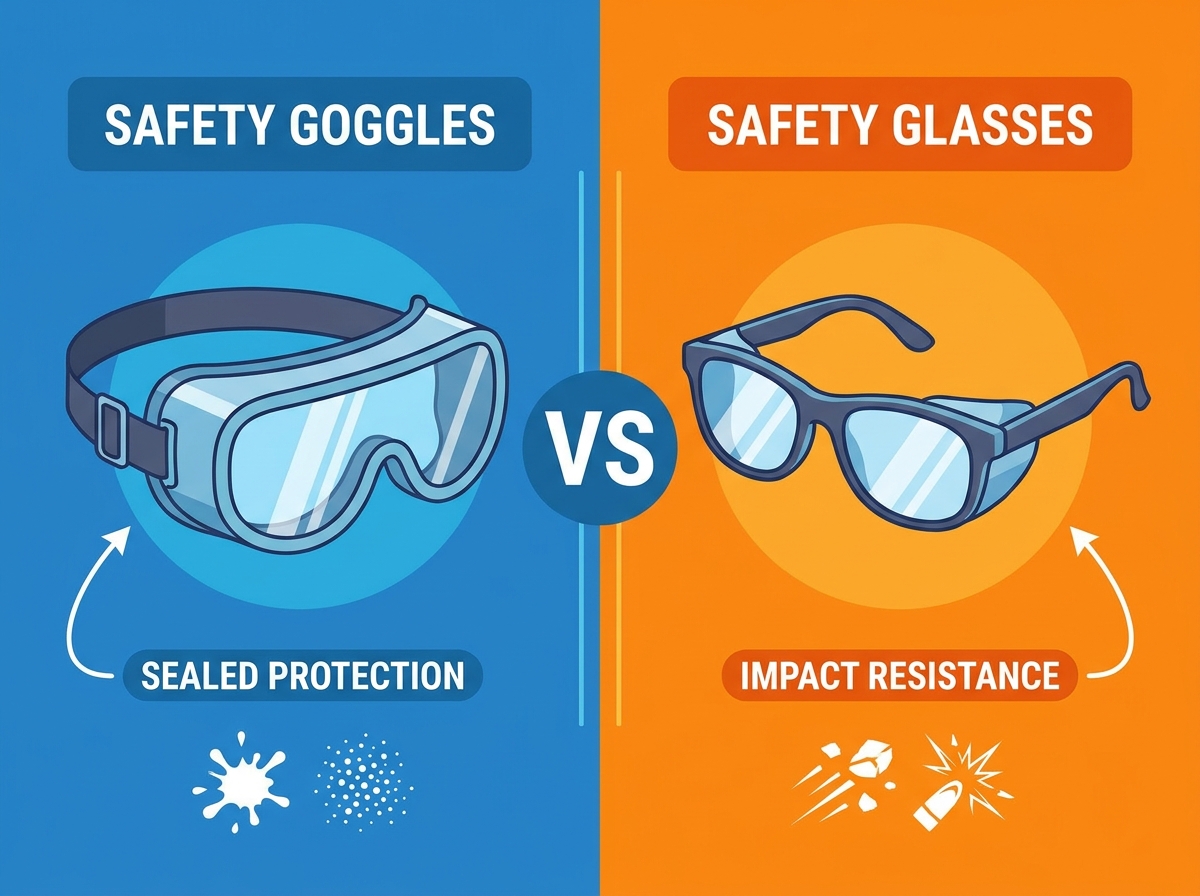
As the standard baseline for daily defense, these glasses are the most commonly deployed form of eye protection across global industries. Engineers design them primarily to mitigate mechanical hazards. They specifically target blunt force impacts and high-velocity projectiles that follow a predictable, ballistic trajectory.
Consider a machinist operating a high-speed lathe. A stray metal shaving ejects directly toward their face. Standard protective frames with side shields deflect this hazard effortlessly. Because they excel at stopping direct, frontal impacts, they are the universal recommendation for general assembly lines, basic carpentry, light manufacturing, and bustling warehouse operations.
The standout advantage here is undeniably user comfort. Weighing mere ounces and free from tight facial compression, workers can comfortably sport them for extended eight-to-ten-hour shifts. They will not suffer from pressure headaches or skin chafing. In addition, the natural ventilation provided by the open architecture makes them exceptionally resistant to fogging, even in humid environments.
Aesthetically, modern iterations often mirror sleek athletic or fashion eyewear. This low-profile appeal significantly boosts worker compliance. When employees feel comfortable and less self-conscious, they are far less likely to remove their gear out of frustration.
Ironically, the greatest strength of this equipment is also its fatal flaw in certain environments. The open, ventilated design leaves the eyes entirely vulnerable to hazards that do not travel in a straight line. They offer virtually zero protection against liquid chemical splashes, fine airborne silica dust, mists, or hazardous vapors. Deploying them in an environment where these specific threats loom is a critical, potentially blinding safety failure.
When a rigorous workplace hazard assessment identifies risks that easily bypass frontal defenses, safety managers must immediately escalate their protocols. Robust, sealed devices become strictly necessary for high-risk environments where hazards are fluid, multidirectional, or microscopic in nature.
Picture a laboratory technician accidentally dropping a beaker of caustic acid. In this unpredictable scenario, the splash travels upward and sideways. Only the tight seal of unvented protective goggles prevents a tragic chemical burn. They are equally mandatory in heavy woodworking facilities, clinical laboratories, and construction zones saturated with fine airborne particulates like cement dust.
The absolute, non-negotiable advantage is the complete facial seal. This tight barrier provides unparalleled defense against chemical splashes, hazardous mists, and floating dust. Premium models utilize soft PVC frames and adjustable elastic straps. This combination offers superior force distribution against heavy, multidirectional impacts while adapting seamlessly to varying facial structures.
Depending on the specific ventilation style chosen, these devices can be meticulously tailored. Direct, indirect, or non-vented designs block out everything from large liquid droplets to microscopic gas molecules. This ensures a reliable barrier that standard frames simply cannot replicate.
Because they establish a sealed micro-environment, they naturally trap radiating body heat and moisture. If not paired with appropriate indirect ventilation valves or treated with premium anti-fog coatings, they are highly susceptible to condensation. Fogged lenses obscure a worker's vision, creating secondary, often deadly, safety hazards. Furthermore, the tight seal and strap can feel bulky and restrictive over long periods. This sometimes prompts workers to temporarily remove them to wipe away sweat, causing a dangerous breach in compliance.
To assist procurement officers at the critical decision stage, evaluating these two options directly across specific performance criteria is essential. Resolving this debate requires matching the equipment's certified capabilities to the exact nature of the ambient hazard.
Evaluation Criteria | Safety Glasses | Safety Goggles | Winner / Recommendation |
|---|---|---|---|
Impact Resistance | High. Excellent for direct, high-velocity frontal impacts. | Very High. Absorbs and distributes impact force across the facial seal. | Tie. Both achieve ANSI Z87+ ratings, but goggles offer slightly better force distribution. |
Chemical Splash & Vapor | None. Gaps allow liquids and gases to bypass the lenses easily. | Excellent. Indirect or non-vented designs block liquids and vapors entirely. | Protective Goggles. Standard frames should never be used for chemical hazards. |
Airborne Dust & Debris | Moderate. Stops large debris but fails against fine, floating particulates. | Excellent. The 360-degree seal prevents fine dust from reaching the eyes. | Protective Goggles. Mandatory for tasks like drywall sanding or concrete cutting. |
Comfort & Wearability | High. Lightweight, naturally ventilated, and easy to wear all day. | Moderate. Can be bulky, warm, and may cause pressure marks over time. | Safety Glasses. Highly preferred for general tasks due to long-term comfort. |
Fog Resistance | High. Open design allows continuous airflow. | Low to Moderate. Requires anti-fog coatings or specialized venting. | Safety Glasses. Better suited for high-exertion tasks where splashing is absent. |
Both categories of eyewear undergo the grueling ANSI Z87.1 high-mass and high-velocity impact tests. While both effectively halt flying nails or metal shards, Safety goggles possess a slight edge in kinetic energy management. The soft PVC gasket acts as a shock absorber. It distributes the concussive force across the brow and cheekbones. In contrast, standard frames transfer that kinetic energy directly to the fragile bridge of the nose.
In this specific arena, the sealed option wins flawlessly. Standard frames offer zero reliable defense against fluids or gases. Non-vented or indirectly vented models are specifically tested for liquid droplet and splash resistance. They are frequently marked with a D3 code under ANSI standards to guarantee absolute zero penetration.
Standard frames are strictly suited for heavier debris following a ballistic trajectory. Conversely, fine particulate matter hangs suspended in the air. Silica dust produced by grinding concrete easily drifts into the peripheral gaps of unsealed eyewear. Models boasting a D4 dust rating are strictly required to filter out these abrasive micro-particles.
Selecting the correct gear requires a highly systematic approach rather than guesswork. Safety managers must conduct a thorough Job Hazard Analysis to meticulously evaluate the specific risks lurking in each distinct work zone.
The foundational step involves categorizing the exact nature of the threat. Are your employees navigating mechanical hazards like flying objects and protruding machinery? Are they facing chemical hazards such as corrosive liquids and caustic vapors? For strictly mechanical threats, high-impact polycarbonate frames are generally sufficient. However, the presence of chemicals or fine particulates instantly mandates a transition to sealed eyewear.
The physical climate of the workspace plays a massive role in equipment selection. Consider ambient temperature and ambient humidity. In a sweltering, humid manufacturing plant, workers trapped in sealed, non-vented gear will experience rapid lens fogging. In these nuanced cases, safety managers must source indirectly vented models treated with premium hydrophilic anti-fog coatings. This strikes a delicate balance between chemical sealing and optical clarity.
A persistent challenge in workplace safety is accommodating personnel who rely on prescription lenses. Standard protective frames cannot simply be jammed over everyday prescription glasses. Doing so compromises the fit, breaks the protective barrier, and voids the safety rating. The practical solution lies in Over-The-Glass designs. These feature deeper frames and specialized temple channels. Alternatively, facilities can invest in prescription-ready protective inserts.
Different sectors face vastly different daily challenges. Translating hazard assessments into practical equipment choices requires tailored recommendations. This ensures procurement teams make evidence-based decisions that optimize both worker safety and operational efficiency.
Construction sites are highly dynamic environments dominated by mechanical hazards. Workers frequently dodge ricocheting nails, wood splinters, and metallic fragments. In these scenarios, high-impact safety glasses equipped with robust side shields provide optimal defense. They remain lightweight enough to ensure compliance during grueling outdoor shifts. Specifically, when tasks pivot to heavy concrete cutting or drywall sanding, protocols must dictate an immediate switch to sealed gear. This prevents severe corneal abrasions from microscopic dust.
Chemical handling introduces a completely different, highly volatile risk profile. Here, threats manifest as unpredictable liquid splashes and caustic mists. Standard frames offer zero reliable protection in this context. Unvented or indirectly vented models form a completely sealed micro-environment. This neutralizes the risk of capillary action drawing dangerous liquids into the eyes. For highly reactive substances, selecting lenses manufactured from chemical-resistant materials is a critical empirical requirement.
In clinical settings and emergency response scenarios, the focus shifts entirely to biological hazards. The primary threats are the splatter of bodily fluids and bloodborne pathogens. Fluid-resistant frames with extended side coverage may suffice for standard patient examinations. However, trauma centers, surgical environments, or infectious disease isolation wards necessitate comprehensive protection. They require the gap-free seal of specialized medical goggles capable of withstanding rigorous sterilization protocols.
Machinists operating CNC machines and drill presses are primarily at risk from high-velocity metal swarf traveling outward from the machinery. Because these particles follow a predictable path, wrap-around frames offer excellent frontal and lateral protection. Their open ventilation ensures they do not fog up in non-climate-controlled factory settings. They also seamlessly integrate with other required protective gear like hard hats and ear defenders.
Once the hazard assessment is complete, procurement managers face the critical task of translating theoretical needs into tangible safety equipment. Supplying substandard gear not only violates occupational safety regulations but directly endangers the long-term livelihood of the workforce.
Never purchase protective equipment based on aesthetic appearance alone. Authentic gear must be rigorously tested and certified by recognized regulatory bodies. In the United States, look for the ANSI Z87.1 certification stamped directly onto the frame or lens. Ensure the eyewear bears the Z87+ mark for high-velocity impact resistance. Furthermore, check for specific hazard ratings. A D3 rating indicates liquid splash protection, while a D4 denotes defense against dust particles. In European markets, verify compliance with the equivalent EN166 standard.
Securing certified equipment is only the first hurdle. Maintaining a consistent supply chain is equally critical for enterprise-level safety programs. Prioritize partnering with established manufacturers that demonstrate stringent quality control protocols. Consolidating procurement by sourcing a comprehensive suite of gear from a single reliable supplier significantly streamlines inventory management. It ensures uniform quality across all departments.
Before committing to bulk contracts, thoroughly evaluate a manufacturer's production pedigree and compliance history. Establishing a relationship with a transparent, technically proficient vendor guarantees results. It ensures your workforce receives scientifically validated protection meticulously tailored to their specific environmental hazards.
Standard safety frames effectively block direct impacts and ballistic debris. This makes them ideal for general manufacturing and carpentry. Conversely, specialized goggles create a secure, impermeable seal against dangerous chemicals, volatile vapors, and microscopic dust.
The debate between these two forms of protection is ultimately straightforward. Always match your visual safeguards to the specific, assessed hazards of your environment. Providing the correct gear goes far beyond mere regulatory compliance. It is a fundamental commitment to protecting the long-term health and livelihood of your team.
Audit your work environment today. Identify your unique operational risks. Upgrade your safety programs by sourcing certified, high-quality protective eyewear from Relecy. Explore our comprehensive catalog to find the exact match for your facility and ensure your team operates with ultimate visual security.
No. Empirical safety standards explicitly prohibit substituting standard frames for sealed goggles in chemical environments. Even models equipped with wrap-around lenses and side shields inherently leave structural gaps along the cheekbones and brow line. These gaps provide a direct pathway for chemical splashes and caustic mists to reach the eyes. For true chemical protection, occupational safety guidelines require the use of unvented or indirectly vented goggles that form an impermeable, 360-degree facial seal.
ANSI Z87.1 is the authoritative American National Standard for Occupational and Educational Personal Eye and Face Protection Devices. When eyewear carries this certification, it indicates the product has survived rigorous, standardized laboratory testing. A standard Z87 mark denotes basic impact protection. A Z87+ mark signifies the equipment has passed severe high-mass and high-velocity impact tests without shattering or dislodging, proving its reliability in industrial environments.
Fogging is a thermodynamic reaction occurring when warm, moisture-laden air from a worker's face meets the cooler surface of the lens. To mitigate this, prioritize models treated with advanced hydrophilic or hydrophobic anti-fog coatings. Selecting the correct ventilation style is also crucial. If the environment is free from chemical vapors, direct-vented models provide maximum airflow. For chemical environments, indirect-vented models utilize a baffled airflow system that reduces internal heat buildup while blocking liquid ingress.
Yes, but you must select a specific design. Standard goggles will press uncomfortably against your prescription frames, breaking the facial seal and compromising safety. You need Over-The-Glass goggles. These feature deeper lens cavities and slotted frame channels designed specifically to accommodate the temples of prescription eyewear without sacrificing the protective 360-degree seal.
Direct ventilation features open perforations in the frame, allowing maximum airflow to prevent fogging. However, these open holes allow liquids and fine dust to penetrate, making them suitable only for impact hazards. Indirect ventilation utilizes covered, baffled vents. This angled airflow system permits heat and moisture to escape while physically blocking the straight-line trajectory of chemical splashes and hazardous mists.
Yes. The vast majority of modern, industrial-grade lenses are manufactured using high-density polycarbonate. At a molecular level, polycarbonate naturally absorbs and blocks up to 99.9 percent of harmful Ultraviolet A and Ultraviolet B radiation, even if the lens is completely clear. However, while they block UV rays, clear lenses do not reduce visible light glare. Always verify the manufacturer's specific UV rating documentation before deployment.
The lifespan of ocular defense is dictated by environmental exposure, frequency of use, and mechanical wear, rather than a strict expiration date. Replace equipment immediately if the lenses sustain deep scratches, pitting, or chemical clouding. These defects severely compromise optical clarity and structural integrity. For sealed gear, routine inspections of the PVC gasket and head strap are critical. If the seal becomes brittle or warped, it can no longer provide the necessary 360-degree protection.
